
Five-on-Five Hockey: Why It Should Be Separated from Other Strengths
Separate five-on-five play from all situations. A worked example shows how special teams can change an aggregate shot-attempt share.
What five-on-five statistics describe
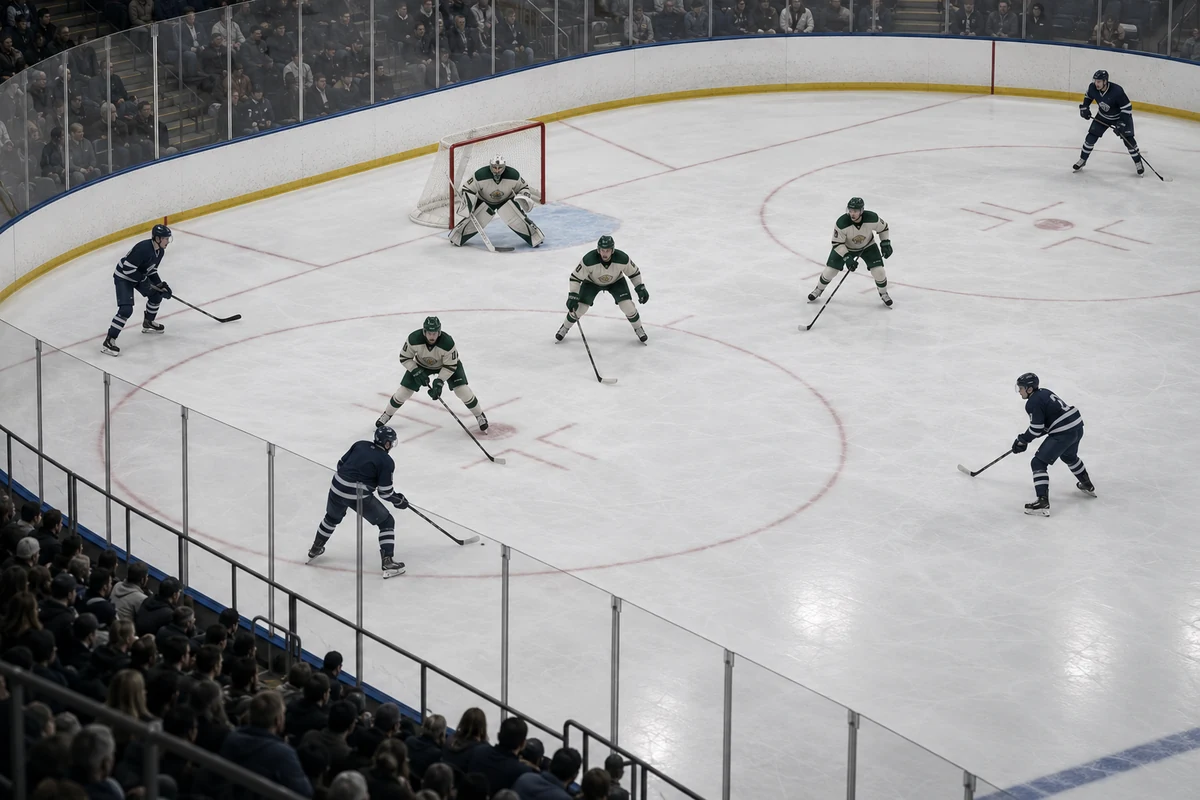
Manpower changes the structure of a hockey game. At five-on-five, each team has five skaters; power plays, penalty kills, empty-net shifts, and overtime create different conditions. An all-situations statistic combines these segments. If a team took many penalties, its shot-attempt total may reflect time shorthanded as much as its even-strength play.
Filtering by manpower helps compare teams with the same number of skaters. Corsi For/Against or attempts per 60 at five-on-five describe that state if the source has filtered the time correctly. Check how a table handles empty nets, short shifts around penalties, and overtime; a label does not guarantee identical rules across reports.
A simple example where the aggregate hides a difference
At five-on-five, a team records 30 attempts and its opponent 20. The team’s Corsi share is 30 / 50 = 60%. During power-play and penalty-kill segments, the combined count is 4 to 6. Adding the states gives 34 to 26, or 56.7%. The team still leads in the aggregate, but its overall share is lower than its five-on-five number. In another game, special teams could reverse the comparison entirely.
These are invented numbers to explain aggregation. They do not mean the team will necessarily play better next time. A 60% share also says nothing about chance quality without additional information about shot locations and goaltending.
Why the segments should stay separate
A power play can create more time in the attacking zone; a penalty kill forces a team to defend. Penalties are not random: an aggressive team may take more, the score can change risk and tactics, and opponents choose their power-play personnel. A game total is useful for describing the final event count, but it does not answer how the team performed at even strength.
Compare five-on-five minutes, lineups, opponent, and score context. An early lead may push one side to attack and the other to protect space. For the distinction between special-team roles, see our guide to power plays and penalty kills. Definitions of shots on goal and their counting are discussed in our hockey shots-on-goal guide.
Reading a betting market
Five-on-five data is only one part of a goals total: penalties, goaltenders, chance quality, and time also matter. For a player-shot market, check his role at even strength and on the power play if he appears there. His per-game attempt total may be boosted by special teams even if he creates little at five-on-five.
Do not compare a power-play regular with a defenseman who spends almost all his time at five-on-five by raw attempts alone; adjust for time and role.
Before drawing a conclusion, record the manpower state, time interval, and events included. That separates even-strength play from special teams and avoids presenting a mixed statistic as a pure five-on-five profile.