
Tennis Court Surfaces: How to Compare Players
Clay, grass, and hard courts change the context of a match, but surface-specific statistics only help when the samples are comparable.
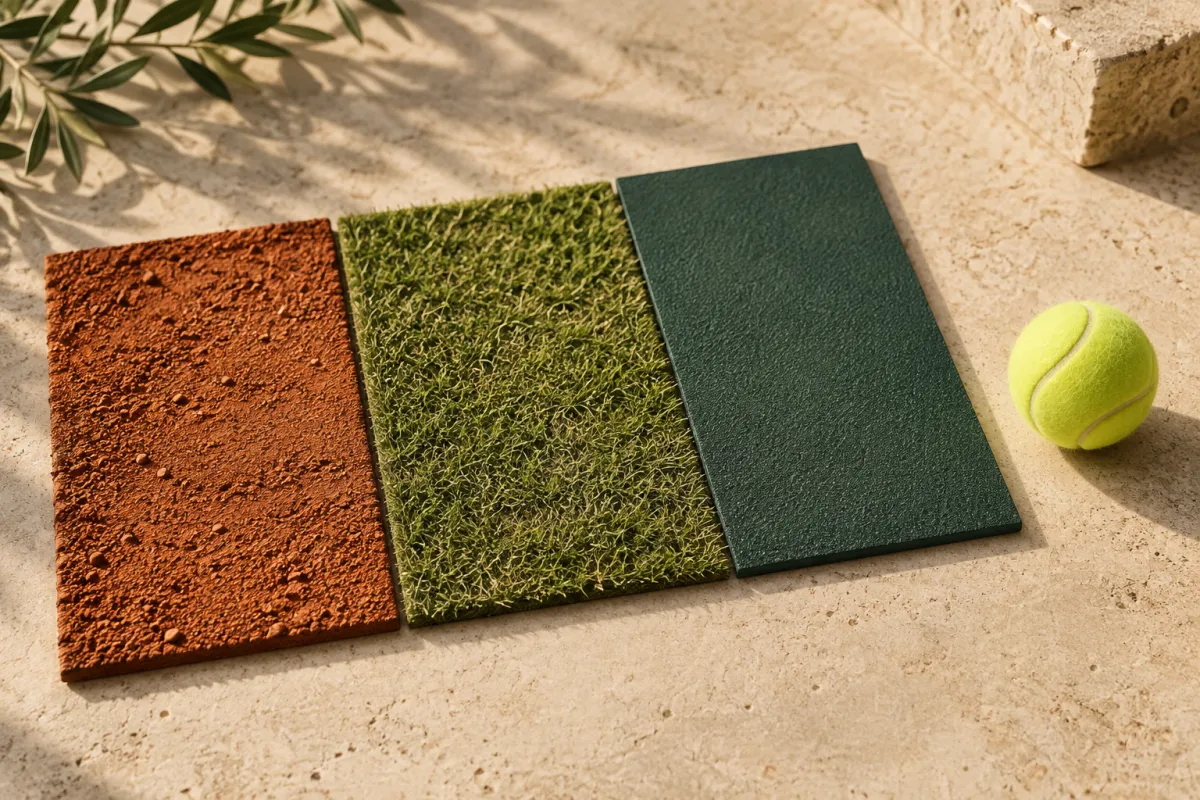
Why court surface changes the context
Tennis is played on clay, grass, and different types of hard court. Surface is only one part of the conditions: the specific court, balls, indoor or outdoor setting, temperature, and player styles matter too. Calling someone a “clay-court specialist” is not a substitute for assessing the actual match.
Start by identifying the surface and comparing like with like. An overall career number may hide that a player has spent most of their time on a different court type. Official sources such as the ITF glossary and ATP statistics help verify surface terminology and apply a surface filter; check that the period and competition level are also comparable.
Look beyond the win rate
Surface win percentage is a useful starting point, but it does not explain why those matches were won. Compare opponent strength, tournament level, season timing, and sample size. Ten wins at smaller events cannot be placed directly beside ten matches against top-ranked opponents.
You can also review playing components: points won on serve, return performance, service games held, and break points converted. If a surface makes first-strike serving more important, that may suit a strong server—but test the idea against the data and the opponents rather than relying on a stereotype about the surface.
Account for a surface change
Early matches after a switch from one surface to another may not be comparable with the middle of a settled surface season. A player may have only a few recent observations, while older results may come from different conditions or fitness levels. Keep long-term records separate from the current stretch instead of treating every match as equally relevant.
The tournament calendar matters too. A clay swing may contain several events, but a result at one tournament does not automatically transfer to another. Check the specific court and opponent level, not only the surface label in the schedule.
A careful comparison
Suppose Player A has more hard-court wins in the database, while Player B has a higher share of first-serve points won. That is not yet a forecast: sample sizes and opponent quality may differ. Write down what you are comparing—for example, matches from the last two seasons, tournament level, surface, and serve metric. If there are few observations, keep the conclusion uncertain.
Cross-check rankings, results, and statistics with official sources, and verify metric definitions with the data provider. Do not use an overall win percentage to fill gaps in surface-specific information. When comparing two players, use the same time filter and do not choose the range after seeing which result is more convenient.
A practical checklist
- Identify the court type and tournament conditions.
- Filter stats by surface and a comparable time period.
- Check the number of matches and opponent strength.
- Separate long-term results from recent form.
- Review serve and return indicators as well as wins.
- Leave the conclusion open when the sample is too small.
Surface helps frame the match; it does not reveal probability on its own. See the tennis match analysis guide.
Read next
Sportexa AI
Apply this to a real match
Choose a match in Sportexa AI and ask the assistant how the available sports data and current odds relate to the idea in this article.
Open the assistant