
Indoor vs Outdoor Tennis: What to Compare
An indoor venue alone does not determine playing pace. Separate the surface, conditions and statistical sample.
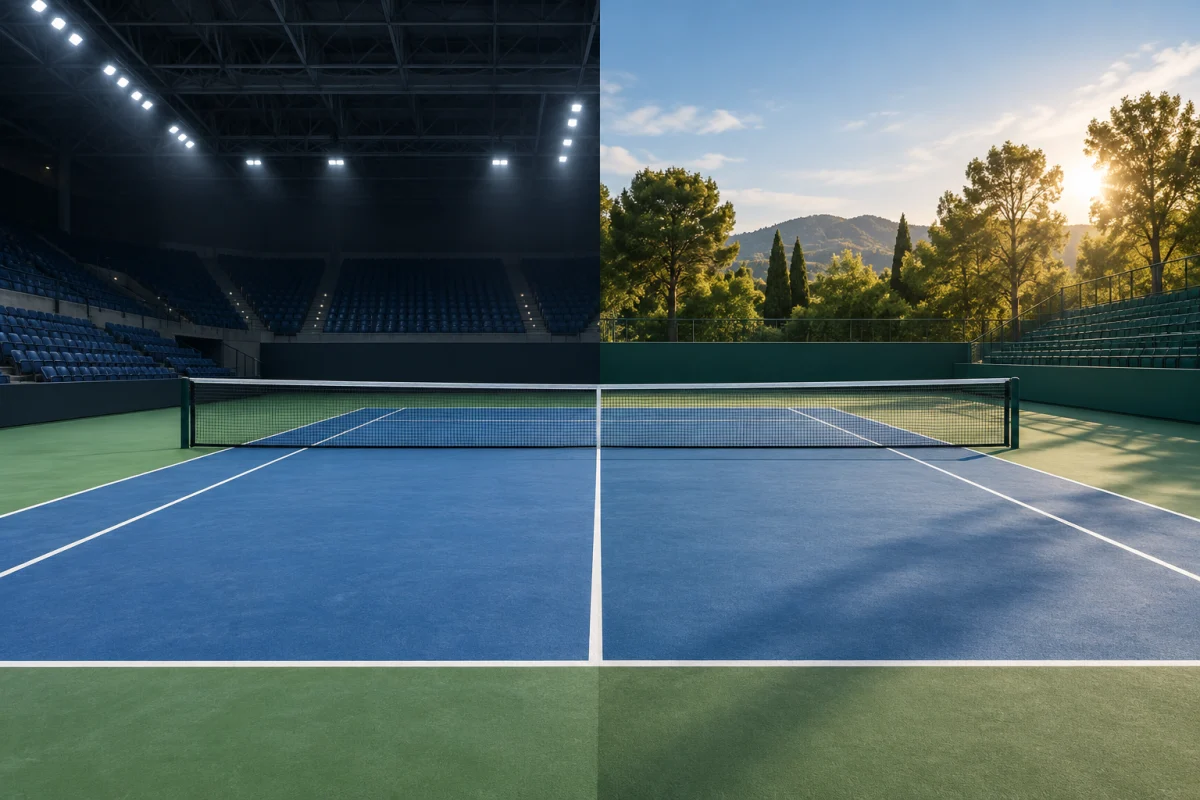
“Indoor” is not a surface type
In statistics, indoor or outdoor describes the playing environment; it does not automatically determine court pace. An indoor court can use one surface and an outdoor venue another. Ball, temperature, humidity, altitude, lighting and scheduling can also differ. You cannot conclude in advance that an indoor match will have more aces or shorter rallies.
The ITF classifies surface products by Court Pace Rating, but that is a rating of the surface under a defined procedure, not a guarantee of the pace in a particular professional match. When comparing serve, return or rally statistics, record surface, venue, tournament, season and data source separately. This matters for aces and service volume, where the number of opportunities also depends on match length.
Compare similar samples
Use matching periods and, where possible, similar tournament types. Note if a player has rarely competed in one setting: a small number of matches cannot establish a stable “indoor effect.” Opponents and draws can differ too, so one season average may reflect the schedule rather than venue conditions alone.
Useful fields include:
- match and set counts for each group;
- surface and, if available, the official surface classification;
- serve and return statistics with their denominators;
- opponent level and match format;
- exact dates, source and consistent sample rules.
Show raw counts beside percentages. If a player won 30% of return games indoors across 10 matches and 20% outdoors across two, the difference needs cautious interpretation. This is an illustrative example: a percentage does not remove the sample-size gap. For the denominator, see return games and opponent quality. Record whether the roof was actually closed during a match: a venue may have a roof, but the indoor status in your dataset should be checked at match level rather than inferred from the arena name.
Do not attribute every difference to venue
A player may have faced one level of opposition indoors and another outdoors. Injuries, coaching changes, tournament format and ball can also matter. If you compare periods, record those changes instead of automatically assigning the difference to weather or a roof.
Before using it in a bet
Venue context may help select relevant historical matches, but it is not a standalone signal. Check current conditions, lineup and market, then compare the price with an estimate built from a comparable sample. Do not transfer a player’s rate on one surface to another without a reason. With little data, acknowledge uncertainty and keep risk limited.
Read next
Sportexa AI
Apply this to a real match
Choose a match in Sportexa AI and ask the assistant how the available sports data and current odds relate to the idea in this article.
Open the assistant