
Tennis Game Totals: Why Set Scores Do Not Tell the Whole Story
The same set score can hide a different number of games. Learn how to read scorelines, tie-breaks, and market rules.
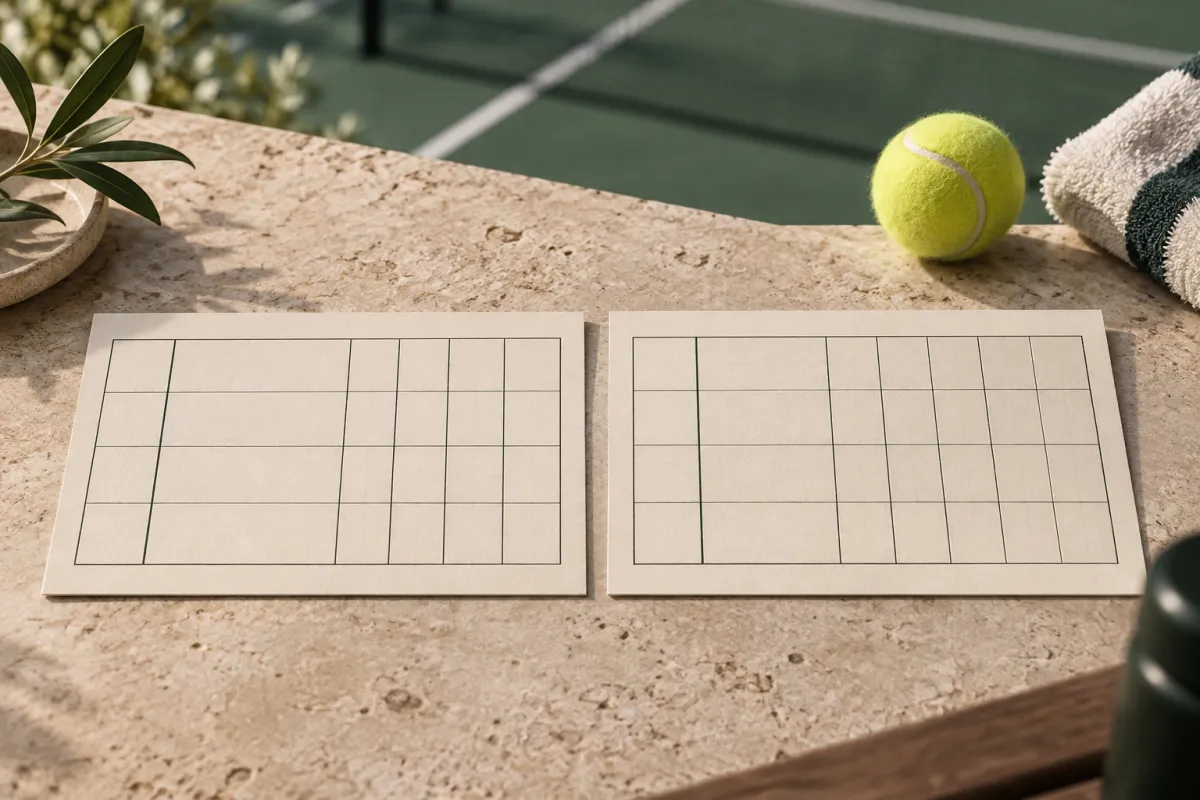
Set score and game count are not the same thing
A match result is often shown as a sequence of set scores. A total-games market, however, depends on every game in each set, including the deciding set and the tie-break format used. Two matches ending in straight sets can have very different totals.
For example, 6–4, 6–4 contains 20 games. A 7–6, 7–6 score contains 26. Both results mean a two-set win, but they differ by six games. “Won in straight sets” is not enough to tell you how many games were played.
Count each set separately
The ITF glossary describes standard set scoring: a player must win six games by a margin of at least two. If the score reaches 6–6, the tournament format may call for a tie-break. A 7–6 set contains 13 games, not 12: the tie-break decides the additional game that gives the set its score. The deciding set can use different rules, including a match tie-break in place of a full set.
Add the games from every set to calculate the match total. Compare 6–0, 6–0, which contains 12 games, with 7–5, 7–5, which contains 24. Both are two-set results, but the amount of play is different. The range comes from the score, not from a predetermined assessment of the players.
Why tie-breaks need attention
A tie-break does not begin at every tied score. It is commonly played at 6–6, but the tournament regulations determine the format. A standard tie-break is won by reaching at least seven points with a two-point margin. It can therefore last longer than seven points. Some competitions use a match tie-break with a different points target in the deciding set.
Check the market’s settlement rules. Some bookmaker rules specify separately how tie-breaks and match tie-breaks count for total-games markets; this is stated, for example, in one operator’s terms. That is an example of operator variation, not a universal rule. If the match format changes or a set is unfinished, the market’s specific terms matter as well.
Match scenarios and sample size
A high share of tie-breaks in a player’s past matches does not guarantee one in the next match. Consider the opponents, surface, match format, serve quality, and number of observations. Do not combine tournaments that use different deciding-set formats.
It is useful to outline a range of score scenarios. Two one-sided sets can produce few games, while two close sets may produce substantially more. This shows how sensitive a total is to the scoreline; it does not tell you which scenario will occur.
Before drawing a conclusion
- Confirm whether the match is best-of-three or best-of-five.
- Check the deciding-set and tie-break format.
- Add the games in each plausible scoreline separately.
- Review how the market rules count a tie-break.
- Compare player statistics on a similar surface.
- Do not infer probability from one run of results.
A game total depends on how long the sets become. For the broader structure of a tennis match, see the tennis match analysis guide.
Read next
Sportexa AI
Apply this to a real match
Choose a match in Sportexa AI and ask the assistant how the available sports data and current odds relate to the idea in this article.
Open the assistant