
A Football Red Card: Reassessing a Match Live
A sending-off changes the number of players, but does not dictate a winner or total. Recheck score, time, player role and market settlement.
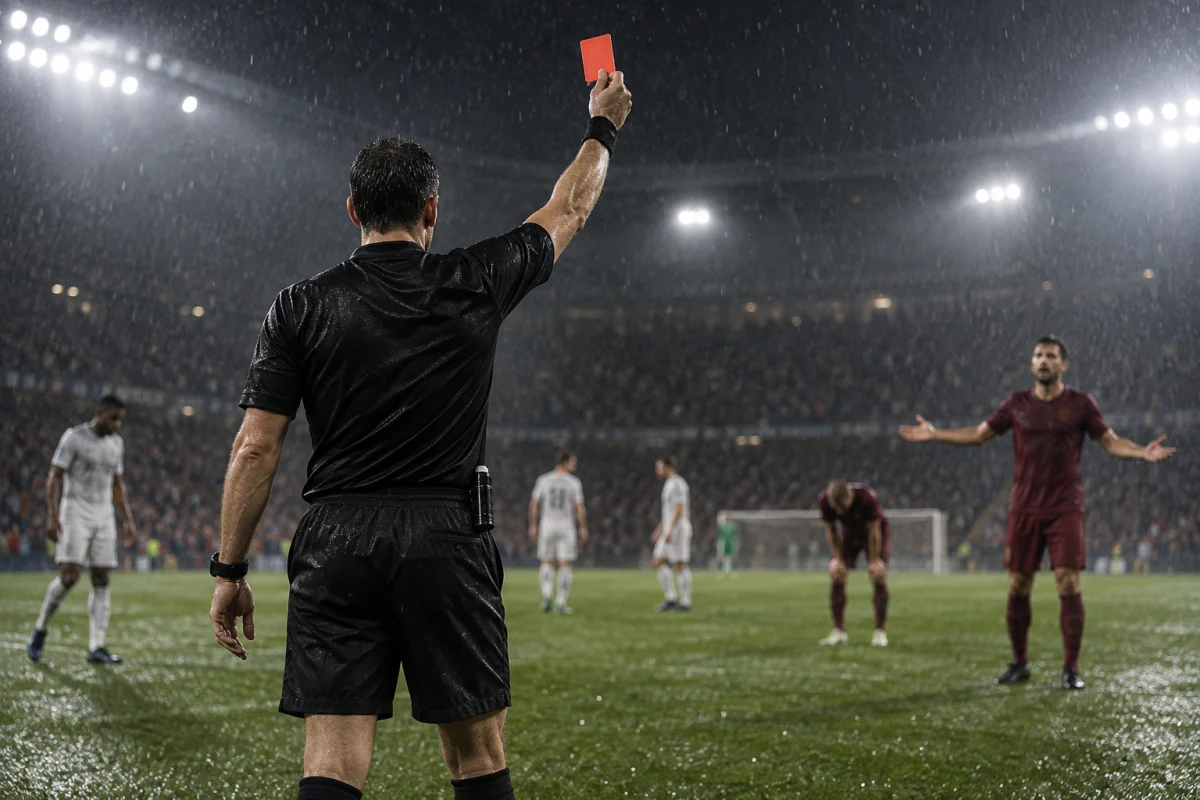
A sending-off changes the setup, not the forecast
After a red card, one team continues with fewer players: under the standard Laws of the Game, a sent-off player cannot be replaced. But the event does not tell you what happens next. One side may defend deeper, the other may try to use width, and an early dismissal is different from one in stoppage time. Shot totals after the incident depend on context. For a comparison of attacking and conceded chances, see xG and xGA.
First confirm the event and timestamp with a reliable live source. Check whether a review is pending and what the displayed score includes. Then record who was sent off, the player’s role, the score and the time remaining. A dismissal of a defender and one of a forward can lead to different reshuffles, but a position label alone cannot predict the match pattern with confidence.
What to reassess
- Score and minute. A team behind may keep attacking with ten players; a team in front may protect its lead.
- Which side lost a player. Whether the favourite or underdog is short-handed changes the starting context, but does not guarantee the opponent’s response.
- Role and substitutions. Check who the coach removes and how the flanks, midfield and back line change.
- Match events. A penalty, injury, VAR delay and chances already created can matter alongside the card.
- Market and period. A regulation-time result, total and next-goal market have different settlement rules and time boundaries.
For example, the same sending-off at minute 20 and minute 85 leaves different time for a team to adapt. This does not give you a ready estimate of the goal total, but it shows why the minute belongs in a live-stat comparison. Also record when the decision became official.
Do not compare pre-card and post-card shot totals without considering the score. It may have changed earlier, and the teams may have adopted different tactics. Research on game state illustrates why attacking volume should be read alongside score and minute; it is not a universal live-prediction formula. For corner markets, also consider tempo and width of attack.
Price and risk
Prices may move before you can assess the new situation. Do not treat a fast odds change as proof that the market is wrong, and do not chase previous losses. If you do not have a validated model updated for dismissals and match state, passing is a reasonable choice.
Check whether the incident applies only to regulation time, how a market is settled after a stoppage or abandonment, and which statistics count for settlement. Review the settlement rules for card markets as well. Live analysis also needs accurate timestamps: a delayed feed may show a price for a situation that has already changed.
Read next
Sportexa AI
Apply this to a real match
Choose a match in Sportexa AI and ask the assistant how the available sports data and current odds relate to the idea in this article.
Open the assistant